

A 2023 study published in the Journal of Nutrition revealed that nearly 50% of fitness enthusiasts miscalculate their daily energy needs by over 500 calories. It's no wonder you feel stuck. You're likely tired of battling confusing scientific jargon and the constant fear that a slight mistake might trigger metabolic damage. We understand that tracking every bite feels like a full-time job, especially when hunger starts to cloud your focus. Achieving your peak physical state shouldn't feel like a math exam. Our science-backed calorie calculator guide is designed to cut through the noise and provide immediate clarity.
Mastering your metabolism should be simplified. This guide delivers a clear daily target tailored to your unique biology, ensuring you're fueled for weight loss, maintenance, or elite performance. You'll gain a professional understanding of the vital difference between Basal Metabolic Rate (BMR) and Total Daily Energy Expenditure (TDEE). We're going to break down advanced tracking methods and hunger management strategies updated for 2026. Ready to feel the difference?
Key Takeaways
- Master the distinction between BMR and TDEE to understand the true energy cost of your daily lifestyle and metabolism.
- Use a science-backed calorie calculator to establish a precise baseline tailored to your 2026 health and performance goals.
- Discover why the traditional 500-calorie rule is evolving and how to find your metabolic "sweet spot" for sustainable results.
- Learn to cross-reference your caloric data with precision tools like BMI for a holistic and professional view of your physical progress.
- Explore simplified ways to bridge the gap between "eating less" and "feeling great" using targeted strategies to manage cravings.
What is a Calorie Calculator and Why Does Accuracy Matter?
A calorie isn't a "unit of guilt" or a measurement of how much you should punish yourself at the gym. It's a scientific unit of heat energy. Specifically, it represents the amount of energy required to raise the temperature of one gram of water by one degree Celsius. Understanding how your body uses food for energy is the first step toward reclaiming control over your health. When you look at food as fuel rather than an enemy, your relationship with nutrition changes instantly.
Weight management operates on the law of energy balance, often called Calories In vs. Calories Out (CICO). It's a simple mathematical equation. If you consume more energy than your body requires for daily functions and physical activity, that energy is stored. If you consume less, your body taps into its reserves. While the concept is simple, the execution is where most people fail. This is why a digital calorie calculator is an essential tool for anyone serious about their health goals in 2026.
Relying on "eyeballing" portions is a gamble that rarely pays off. Research published in the New England Journal of Medicine found that individuals often underestimate their daily caloric intake by an average of 47 percent. Even trained professionals can miss the mark by 20 percent. A digital tool provides a data-driven baseline that removes human error from the equation. VitalSupply24 is committed to providing science-backed tools that offer a simplified health journey. We cut through the noise of the supplement industry to give you the clarity you deserve. Clean ingredients. Zero compromise.
The Core Purpose of Caloric Tracking
Tracking your intake transforms weight management from a mystery into a mathematical certainty. Modern processed foods are engineered to be hyper-palatable, often hiding 300 to 500 "invisible" calories in small, non-satiating servings. A calorie calculator acts as a shield against this hidden calorie trap. By establishing a precise daily target, you build a sustainable baseline for long-term metabolic health. This isn't about restriction; it's about awareness. You can't optimize what you don't measure.
Who Should Use a Calorie Calculator?
Precision is the bridge between effort and results. These tools aren't just for one specific group; they're for anyone who values data-driven wellness:
- Athletes: High-performance bodies require specific fuel ratios to optimize recovery and maintain peak output during training.
- Weight Loss Seekers: For those tired of the "yo-yo" dieting cycle, tracking provides the consistency needed for sustainable fat loss.
- The Health-Conscious: If you're curious about your functional nutrition needs, tracking helps you align your intake with your cellular health goals.
Whether you want to lose 10 pounds or run your first marathon, knowing your numbers is the ultimate form of self-care. Ready to Feel the Difference?
The Science of Metabolism: Understanding BMR and TDEE
Metabolism isn't a fixed number; it's a dynamic biological process. To use a calorie calculator effectively, you must first distinguish between your body's survival needs and its performance needs. Understanding this distinction is the first step toward sustainable body recomposition. Simplified.
BMR: Your Body’s Baseline Energy
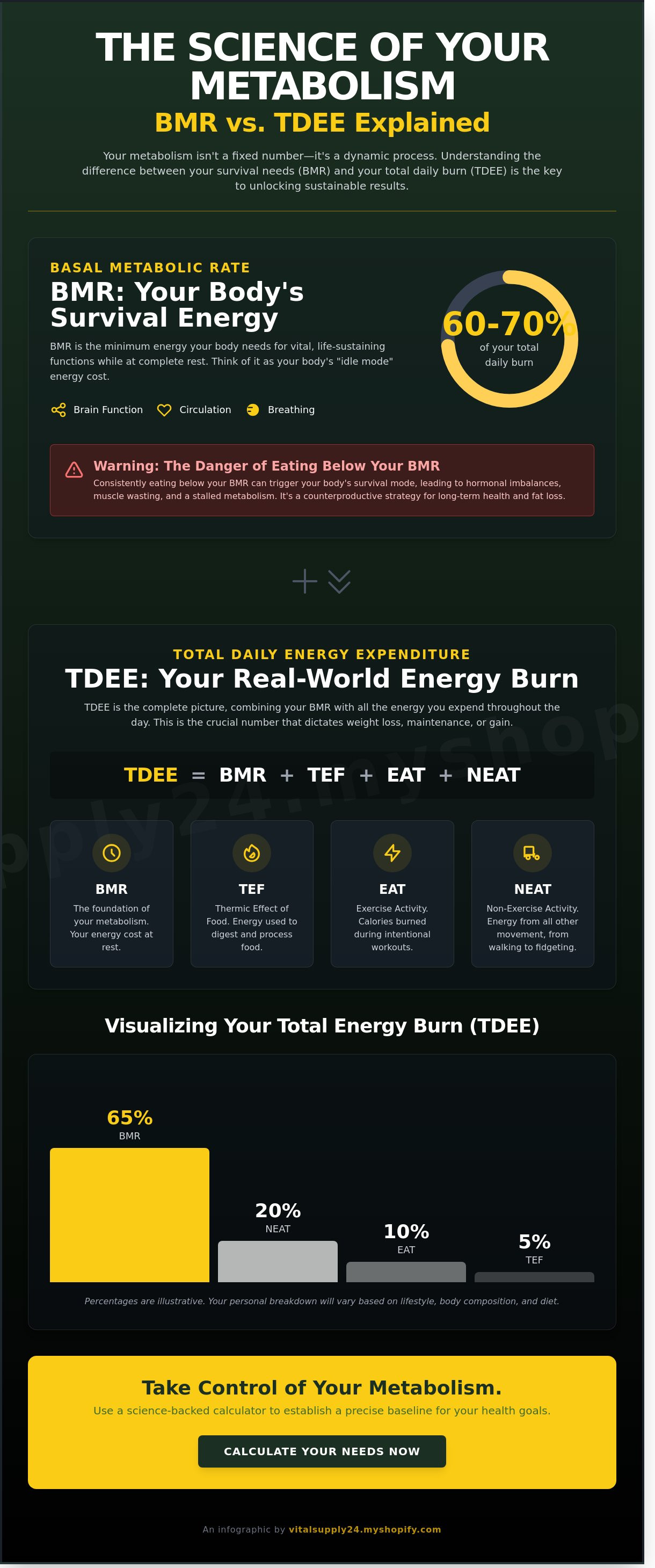
Basal Metabolic Rate (BMR) represents the energy your body consumes to maintain homeostasis. BMR is the minimum energy required for life-sustaining functions like breathing and circulation. Even if you stayed in bed all day, your brain, liver, and kidneys would still demand roughly 60% to 70% of your daily energy. Consistently eating below your BMR is a common mistake that backfires. It leads to hormonal imbalances and muscle wasting. Your body prioritizes survival over fat loss when calories are too low, which eventually stalls your progress and lowers your core temperature.
TDEE: Factoring in Your Lifestyle
Total Daily Energy Expenditure (TDEE) is the real-world number that dictates weight change. It combines your BMR with three critical factors: the Thermic Effect of Food (TEF), Exercise Activity Thermogenesis (EAT), and Non-Exercise Activity Thermogenesis (NEAT). For a precise strategy, the NIH Body Weight Planner offers an interactive way to see how these variables interact over time. Most people overestimate their exercise burn but underestimate the power of NEAT. Daily steps and standing can account for up to 15% of your total burn. Digestion also requires energy; high-protein diets increase your TEF, meaning you burn more calories just by processing your meals.
The Mifflin-St Jeor Equation is the engine behind every reliable calorie calculator in 2026. Clinical research consistently shows it's the most accurate formula for modern populations, often staying within a 10% margin of error. It calculates energy needs based on weight, height, age, and biological sex. However, your "Metabolic Fingerprint" still matters. Factors like muscle mass significantly alter the math. One pound of muscle burns approximately six calories per day at rest, while a pound of fat burns only two. As you age, BMR typically drops by 2% to 3% per decade, largely due to natural muscle loss.
Clean Ingredients. Zero Compromise. Maintaining lean tissue through resistance training and proper protein intake is the best way to keep your metabolism "young" and efficient. Ready to fuel your progress? Check out our advanced nutritional support to stay on track and protect your hard-earned muscle mass.
Setting Your Goals: Weight Loss, Maintenance, or Muscle Gain
Your calorie calculator result is a baseline, not a final destination. To transform raw data into physical results, you must align your daily intake with your specific metabolic objectives. The official Dietary Guidelines for Americans emphasize that calorie needs are highly individualized based on life stage and activity levels. In 2026, we've moved beyond the rigid "500-calorie rule" of the past. While cutting 500 calories daily can work, it's often too aggressive for smaller individuals or too conservative for athletes. Modern nutrition focuses on percentage-based adjustments to maintain metabolic health.
Finding your "Sweet Spot" for maintenance is about more than just staying the same weight. It's the caloric level where your energy peaks, your hormones stabilize, and your sleep quality improves. If you've been chronically dieting, returning to maintenance can actually "reset" your metabolism, making future fat loss efforts more effective. It's about finding the balance where you feel your best every single day.
Calculating for a Caloric Deficit
For sustainable fat loss, aim for a 10-20% reduction from your Total Daily Energy Expenditure (TDEE). This range is large enough to trigger fat oxidation but small enough to prevent "starvation mode," a state where the body downregulates non-essential functions like hair growth and thermogenesis. Success in a deficit requires two non-negotiable factors:
- ✓ Increased Protein: Aim for 1.6 to 2.2 grams of protein per kilogram of body weight to protect muscle tissue.
- ✓ Optimized Recovery: Sleep is the most underrated fat-loss tool. Many high-performers use melatonin gummies to ensure deep, restorative sleep cycles, which regulate the hunger hormones ghrelin and leptin.
Clean Ingredients. Zero Compromise. This approach ensures you lose fat, not just weight.
Fueling for Muscle and Performance
Building lean muscle requires a "Slight Surplus" rather than a "dirty bulk." Adding a massive amount of calories usually leads to 70% fat gain and only 30% muscle. Instead, add 250-500 calories above your maintenance level. This controlled increase provides the energy needed for protein synthesis without the metabolic baggage of excessive adipose tissue.
Nutrient timing is vital here. Consuming a significant portion of your daily carbohydrates around your workout window ensures that the calorie calculator surplus is directed toward glycogen replenishment and muscle repair. Don't rely solely on the scale; use monthly progress photos and waist measurements. If your strength in the gym is increasing while your waist stays stable, you're in the hypertrophy sweet spot. Simplified.
Ready to Feel the Difference?
Beyond the Numbers: How to Track and Adjust Your Progress
Data without action is just noise. To transform your health in 2026, you need a systematic approach to your metabolism. Your calorie calculator results provide a scientific starting point; consistency provides the results. A 2023 study published in the Journal of Medical Internet Research confirmed that individuals who track their intake at least five days a week lose 2.5 times more weight than those who track sporadically.
- Step 1: Use the calorie calculator to establish your TDEE baseline. This represents your energy "break-even" point.
- Step 2: Cross-reference your results with a BMI calculator. This provides clinical context for your current weight category and helps set realistic, healthy targets.
- Step 3: Track every calorie for 7 consecutive days. Precision is vital during this initial calibration phase.
- Step 4: Analyze your biofeedback. If your energy levels dip or gym performance suffers, increase your daily intake by 100-calorie increments until you feel stable.
Tools for Precision Tracking
Accuracy is the bridge between effort and results. Digital apps provide speed and massive databases, while analog journals often lead to 15% better food choices due to increased mindfulness. For the first 14 days, use a digital scale. Research shows that volume-based measurements, such as measuring cups, can be inaccurate by as much as 25% for calorie-dense foods like nuts or grains.
✓ Clean Ingredients. Zero Compromise. Apply this logic to your plate. Focus on high-bioavailability whole foods to ensure your body processes energy efficiently without the inflammatory drag of ultra-processed additives. Simplified nutrition leads to sustainable success.
Dealing with Weight Loss Plateaus
The scale is a blunt instrument. It measures fat, muscle, bone, and water. If your weight stalls for 10 days, it's often water retention rather than a failure of your deficit. This is frequently called the "Whoosh Effect." Fat cells can temporarily fill with water as they empty of triglycerides; eventually, the body releases that fluid in a sudden, noticeable drop on the scale.
Metabolic adaptation is a survival mechanism. If progress halts for more than 21 days, implement a "Maintenance Break." Eating at your TDEE for 7 to 10 days can help reset leptin levels and reduce cortisol. This physiological reset often restarts fat loss once you return to a modest deficit. Science shows that periodic breaks can prevent the metabolic slowdown associated with long-term dieting.
Ready to optimize your performance? Shop our premium wellness solutions designed to support your metabolic health and energy levels.
Simplified Support: Optimizing Your Caloric Journey with VitalSupply24
Data is powerful, but data alone doesn't change your physique. Once your calorie calculator results define your daily limits, the real work begins. Transitioning from a caloric surplus to a deficit often triggers a 25% increase in cortisol, the body's primary stress hormone. This biological shift can lead to fatigue, irritability, and intense hunger. VitalSupply24 helps you manage this transition with precision. We provide targeted tools to ensure your body doesn't just survive on fewer calories; it thrives. Our goal is to bridge the gap between "eating less" and "feeling great" through science-backed supplementation.
Managing Cravings and Metabolism
Controlling hunger is the most significant hurdle when following the numbers provided by your calorie calculator. Research indicates that acetic acid, the active component in apple cider vinegar (ACV), helps stabilize blood sugar levels and slow gastric emptying. This process keeps you feeling full for longer periods, reducing the urge to snack between meals. If you're unsure which support tool fits your lifestyle, our Golly gummies comparison helps you find your specific metabolic match for 2026.
Workouts shouldn't suffer just because you're eating for weight loss. Maintaining high-intensity output is essential for preserving lean muscle mass. Goli Beets Gummies support circulation and nitric oxide levels, ensuring your muscles receive adequate oxygen during training sessions. This boost is vital for maintaining energy levels when your carbohydrate intake is restricted. It's about high-performance wellness without the burnout.
Cognitive function is another area that often takes a hit during caloric restriction. Brain fog can set in when the body shifts its energy priorities. Our Neuro supplements utilize nootropics and clinically studied ingredients to support mental clarity and focus. You can stay sharp at work and present at home while your body focuses on its metabolic goals. We believe in a zero compromise approach to health.
The VitalSupply24 Promise
We prioritize bioavailability and clean ingredients in every formula we curate. Every product is premium and third-party tested to ensure you're getting exactly what's on the label. We've simplified wellness for the modern, busy individual who doesn't have time for fluff or fillers. You've done the math; now let us provide the support to hit your targets.
- ✓ Third-party lab tested for purity and potency.
- ✓ Science-backed formulas designed for real-world results.
- ✓ Simplified routines that fit into a demanding schedule.
- ✓ Advanced ingredients like KSM-66 and NAD+ for total body support.
Ready to Feel the Difference? Shop our curated wellness collection and take the next step in your caloric journey today.
Take Control of Your 2026 Health Journey
Achieving your peak physical potential requires more than guesswork; it demands a precise understanding of your body's unique metabolic requirements. By utilizing a science-backed calorie calculator, you transform abstract data into a personalized blueprint for weight loss, maintenance, or muscle gain. Precision is the foundation of success. Understanding your TDEE allows you to make informed decisions that yield measurable results rather than temporary changes. Consistency in tracking is your most powerful tool for long-term health.
VitalSupply24 streamlines this process by removing the complexity from your daily supplement routine. Our advanced formulas are science-backed and third-party tested to ensure you receive only the highest quality nutrients. We've earned the trust of over 500,000 customers by prioritizing clean ingredients and zero compromise. It's simplified wellness designed for your busy lifestyle. You don't have to navigate the science alone when you have premium support in your corner.
Ready to Feel the Difference? Shop VitalSupply24 Now
Your path to optimal energy and health is ready for you to claim. Take the first step toward a stronger, more vibrant version of yourself today.
Frequently Asked Questions
How accurate are calorie calculators really?
Calorie calculators provide a high-quality baseline but aren't perfect scientific instruments. A 2023 study in the Journal of the Academy of Nutrition and Dietetics indicates these formulas are accurate within 10 percent for 82 percent of healthy adults. They're a science-backed starting point for your journey. Use your results as a roadmap, not a rigid rule. Simplified.
How many calories should I eat to lose 1 pound a week?
You need a 500-calorie daily deficit to lose 1 pound per week safely. This math is based on the 3,500-calorie rule, where one pound of body fat equals roughly that amount of energy. Consistently hitting this target ensures steady progress without compromising your metabolic health. Ready to feel the difference?
Does the type of calorie (protein vs. carb) matter for weight loss?
Macronutrient composition matters significantly for body composition and satiety. Protein has a thermic effect of 20 to 30 percent, meaning your body burns more energy processing it than carbs or fats. A 2024 clinical review highlights that higher protein intake preserves lean muscle during a deficit. Clean ingredients. Zero compromise.
Can I lose weight without exercise if I stay in a caloric deficit?
You can lose weight through diet alone by maintaining a consistent caloric deficit. Data from a 2022 meta-analysis shows that nutritional changes drive 75 percent of initial weight loss success. While exercise boosts cardiovascular health and muscle tone, your intake is the primary lever for fat loss. Wellness, simplified.
What happens if I eat fewer calories than my BMR?
Eating below your Basal Metabolic Rate (BMR) can trigger metabolic adaptation and muscle wasting. Research indicates that extreme calorie restriction can lower your resting metabolic rate by 15 percent as the body enters survival mode. It's vital to fuel your organs properly. Science-backed nutrition avoids these dangerous shortcuts.
How often should I recalculate my calorie needs?
Recalculate your needs every time you lose 5 to 10 pounds. As your body mass decreases, your calorie calculator requirements change because a smaller body requires less energy to function. Updating your stats every 30 days keeps your plan precise and effective. Verified results require updated data.
Is a 1200-calorie diet safe for everyone?
A 1200-calorie diet is generally insufficient for most active adults and can lead to nutrient deficiencies. Harvard Medical School recommends a minimum of 1,200 calories for women and 1,500 for men to prevent malnutrition. Falling below these levels often leads to fatigue and micronutrient gaps. Your health deserves a more sustainable, bioavailable approach.
Why am I not losing weight even though I am counting calories?
Tracking errors or metabolic plateaus are the most common culprits for stalled progress. A landmark study in the New England Journal of Medicine revealed that people often underreport their actual intake by 47 percent on average. Use a digital scale to ensure your calorie calculator inputs are 100 percent accurate. Precision leads to results.
