

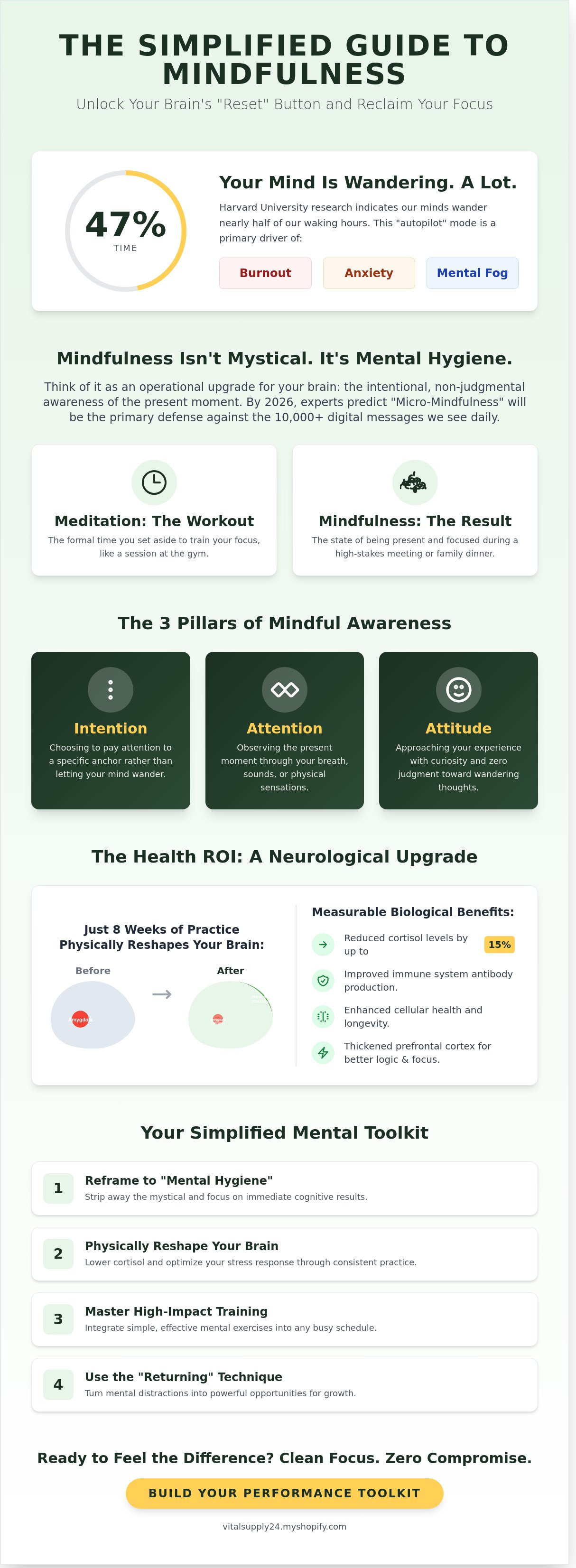
What if your brain had a "reset" button that actually worked in under 180 seconds? Research from Harvard University indicates that our minds wander 47% of the time, which is a primary driver of the burnout and anxiety many high-performers feel today. You're likely tired of the mental fog that sets in by mid-afternoon, making it difficult to implement effective mindfulness practices that actually stick. It's common to feel that traditional meditation is too difficult or simply doesn't fit into a fast-paced lifestyle. You want results, not another chore.
We promise a better way. By mastering specific, science-backed techniques, you can reduce cortisol levels and reclaim your focus in minutes. Our "Simplified" approach focuses on high-impact mental strategies that deliver measurable results in your cognitive performance and sleep quality. We've done the hard work of vetting the research so you can stop guessing and start feeling the difference immediately. Clean focus. Zero compromise.
This guide provides three actionable tools to manage daily stress, improve your deep sleep cycles, and build a simplified routine that sticks throughout 2026. Ready to feel the difference?
Key Takeaways
- Reframe mindfulness as essential "mental hygiene" to strip away the mystical and focus on immediate cognitive results.
- Discover how consistent mindfulness practices physically reshape your brain to lower cortisol and optimize your stress response.
- Master the "Simplified 5" framework to integrate high-impact mental training into even the busiest professional schedule.
- Learn to turn common mental distractions into powerful opportunities for growth using the science-backed "returning" technique.
- Build a personalized performance toolkit that combines advanced mental habits with premium nutritional support for maximum clarity.
What Are Mindfulness Practices? Simplified.
Mindfulness isn't a mystical ritual reserved for mountain retreats. It's mental hygiene. Pure and simple. At its core, mindfulness is the intentional, non-judgmental awareness of the present moment. Think of it as an operational upgrade for your brain. It's the process of tuning into your current experience without the urge to fix, change, or criticize it. This practice allows you to observe thoughts as passing events rather than absolute truths.
By 2026, health experts expect "Micro-Mindfulness" to be the primary defense against digital saturation. We're currently exposed to as many as 10,000 digital messages every single day. This constant stimulus fractures our focus and keeps the nervous system in a state of high alert. You can find a comprehensive overview of mindfulness that explores how these concepts have transitioned from ancient traditions into essential tools for modern cognitive health. For the busy professional, mindfulness practices are about efficiency, not just relaxation.
It's vital to distinguish between the exercise and the state. Meditation is the formal workout. It's the time you set aside to train your focus, much like a session at the gym. Mindfulness is the state of being that results from that training. It's the ability to remain present during a high-stakes meeting or a quiet family dinner. One is the training; the other is the daily strength you gain. Advanced wellness starts with this distinction. Simplified.
The Three Pillars of Mindful Awareness
To master mindfulness practices, you need a structured framework. We focus on three specific pillars to ensure your mental clarity is science-backed and sustainable.
- ✓ Intention: Choosing to pay attention to a specific anchor rather than letting your mind wander.
- ✓ Attention: Observing the present moment through your breath, immediate sounds, or physical sensations.
- ✓ Attitude: Approaching the experience with curiosity and zero judgment toward your wandering thoughts.
Mindfulness vs. Mindlessness
Most adults spend roughly 47% of their waking hours in a state of mindlessness. This is the "autopilot" mode. You've likely experienced it while scrolling through a social feed for 30 minutes or finishing a meal without actually tasting it. This lack of awareness has a high cost. It drains cognitive energy and can increase perceived stress levels by up to 22% in high-pressure environments. Mindlessness is a leak in your daily productivity. Mindfulness is a mental reset button for the nervous system. By shifting out of autopilot, you reclaim your energy and focus. Ready to feel the difference?
The Health ROI: Why Your Brain Needs Mindfulness
Your brain isn't a fixed machine. It's a dynamic organ capable of physical restructuring. When you commit to consistent mindfulness practices, you aren't just "calming down." You're performing a neurological upgrade. Research from Harvard University indicates that just eight weeks of practice can increase gray matter density in the prefrontal cortex. This is the brain’s command center for focus and executive function. At the same time, the amygdala, the region responsible for your "fight or flight" response, physically shrinks. The result is a brain that's less reactive and more resilient. It's cognitive health, simplified.
- ✓ Reduced cortisol levels by up to 15%
- ✓ Improved immune system antibody production
- ✓ Enhanced cellular health and longevity
- ✓ Thickened prefrontal cortex for better logic
Lowering cortisol is critical for long-term health. High stress levels flood the body with hormones that trigger inflammation and fatigue. By learning how to practice mindfulness, you regulate these internal chemical spikes. This biological shift directly supports your overall stress management strategy; it ensures your body doesn't stay in a state of high alert. Integrating these mindfulness practices into your routine isn't just a lifestyle choice; it's a strategic investment in your biological resilience.
Cognitive Performance and Focus
In a world of constant notifications, your brain's "attention switching" efficiency determines your productivity. Multitasking is often a myth. The brain actually jumps between tasks, losing energy with every leap. Mindfulness acts as a natural nootropic. It sharpens your ability to return to a single point of focus, which improves memory retention and decision-making clarity. A 2013 study published in Psychological Science found that students practicing mindfulness improved their GRE reading comprehension scores by 16 percentile points. It's the ultimate tool for cognitive enhancement without the crash.
Emotional Regulation and Resilience
Resilience isn't about avoiding stress. It's about how quickly you bounce back. Mindfulness creates a vital "gap" between a stimulus and your response. Instead of an immediate emotional outburst during a difficult meeting, you gain the clarity to choose a constructive path. This builds a "resilience muscle" that's essential for navigating workplace setbacks. For a complete approach to physical and mental recovery, follow this checklist on how to relax. Ready to optimize your mental clarity? Explore our advanced wellness solutions to support your journey.
5 Essential Mindfulness Practices for Busy Lifestyles
Optimal mental performance doesn't require hours of meditation. We use the "Simplified 5" framework to deliver high-impact results in minimal time. Success in mental training depends on one specific rule: consistency beats duration every time. Research shows that short, daily mindfulness practices are more effective for rewiring the brain than infrequent, long sessions. It's about frequency, not intensity.
Prep your environment for success before you begin. Even in a noisy office, you can create a "zen zone" by using noise-canceling headphones or simply clearing your desk of clutter. Use "anchors" to keep you grounded. An anchor is a physical sensation, like your breath or the feeling of your feet on the floor, that brings you back to the present when your mind starts to wander. Simplified.
1. Mindful Breathing (The 4-7-8 Technique)
The breath is the most reliable mindfulness anchor because it's always with you. The 4-7-8 technique provides immediate calm by regulating the nervous system. Follow this rhythm:
- ✓ Inhale through your nose for 4 seconds.
- ✓ Hold your breath for 7 seconds.
- ✓ Exhale completely through your mouth for 8 seconds.
Practice this before high-stakes meetings or difficult conversations. It's a science-backed tool for instant stress reduction. Zero compromise.
2. The 5-4-3-2-1 Sensory Grounding Exercise
Anxiety often pulls your focus into a hypothetical future. Grounding pulls you back to the "now." Identify 5 things you see, 4 things you feel, 3 things you hear, 2 things you smell, and 1 thing you taste. This exercise is perfect for "on-the-go" mindfulness during commutes or walks. For a broader range of techniques, you can explore these mindfulness exercises from the Mayo Clinic to see what fits your routine best.
3. Mindful Eating: Savoring Your Nutrition
Stop treating lunch as a chore. Transform it into a restorative practice by focusing on the texture, temperature, and food quality of every bite. This simple shift improves digestion and prevents overeating by giving your brain time to register fullness signals. Premium nutrition deserves your full attention. Savor it.
4. The Body Scan for Physical Release
Take 3 minutes for a mental "sweep" from your toes to your head. Identify where you hold tension, such as a clenched jaw or tight shoulders. Use your breath to "send" relaxation to those specific areas. This physical release is a staple in our insomnia tips for those looking to restore their natural sleep cycle through deep relaxation before bed.
5. Micro-Mindfulness: The "One-Minute Reset"
Build a habit of checking in with yourself throughout the workday. Set "mindfulness triggers" like opening a new browser tab or receiving a notification. When the trigger happens, use the STOP acronym:
- S - Stop what you're doing.
- T - Take a breath.
- O - Observe your thoughts and feelings.
- P - Proceed with your task.
These mindfulness practices ensure you stay in control of your day rather than letting the day control you. Ready to feel the difference?
Overcoming Common Mindfulness Obstacles
Many people abandon mindfulness practices because they believe their mind is too loud or their schedule is too full. This is a misunderstanding of how the brain works. Mindfulness isn't a state of permanent silence; it's a process of active management. You don't need to be a monk to succeed. You just need a strategy that fits your modern life. Wellness, simplified.
The Busy Mind Fallacy
The most common myth is the idea that you must stop your thoughts. This is impossible. Your brain is designed to produce thoughts just as your heart is designed to beat. Think of your thoughts as clouds passing through the sky. You are the sky, stable and vast, while the clouds are temporary weather patterns. Noticing you are distracted is actually the moment of mindfulness. Every time you catch your mind wandering and gently bring it back, you are performing a mental repetition that strengthens your focus. It's not a failure; it's a win.
Finding Your Optimal Time and Space
Consistency beats intensity every time. To make mindfulness practices stick, you must anchor them to existing habits. This creates a "Mindfulness Trigger" that removes the friction of decision-making. You might practice for three minutes right after your morning coffee or immediately before taking your Goli gummies to start your day. Clean ingredients. Zero compromise.
- Morning People: Use the quiet hours before the world wakes up to set your intention.
- Evening People: Practice before bed to signal your nervous system that it's time to downshift.
- The On-The-Go Method: Use "dead time" like standing in a checkout line or waiting for an elevator to take three conscious breaths.
Physical restlessness is another hurdle. If your legs ache or you feel twitchy, don't fight it. Acknowledge the sensation without judgment. If the discomfort is too much, adjust your posture. Mindfulness shouldn't be a test of physical endurance. If you feel you don't have time, apply the 1% Rule. There are 1,440 minutes in a day. Spending just 14 minutes on your mental health represents 1% of your day. Even five minutes provides a clinically studied reduction in cortisol levels. Start small. Stay consistent.
Ready to support your mental clarity with premium, science-backed nutrition? Shop our full collection of wellness essentials.
Ready to Feel the Difference?
Building Your Personalized Mindfulness Toolkit
Effective mindfulness practices require more than just a quiet room and a yoga mat. To see real results, you must address the biological foundations of stress. We call this the Inside-Out approach. It pairs mental discipline with premium nutrition to ensure your nervous system isn't working against you. When your body is flooded with cortisol, sitting in silence feels like an uphill battle. By stabilizing your internal chemistry, you lower the biological floor of stress and make peace accessible.
This isn't about finding more time in your day. It's about making the time you have more effective. High-performance wellness is built on science-backed support that clears the mental fog. You don't need a complex 90-minute ritual to see a change. You need a streamlined system that works with your biology. Wellness, Simplified.
The Synergy of Adaptogens and Awareness
Biology dictates your ability to focus. Clinical studies indicate that Ashwagandha benefits include a measurable reduction in serum cortisol levels, with some trials showing a 28% decrease over an eight-week period. This reduction is vital because it physically calms the "fight or flight" response. When cortisol is low, entering a mindful state becomes natural rather than forced.
Our Neuro supplements take this a step further by supporting the Focus pillar of mindfulness. These formulas use clean ingredients to enhance cognitive clarity, allowing you to direct your attention where it matters most. We remove the guesswork so you can focus on the practice.
- ✓ Clean Ingredients. Zero Compromise.
- ✓ Third-party tested for purity.
- ✓ Clinically studied dosages.
Creating a Sustainable Routine
The secret to long-term success is the "Gummy + Grounding" habit stack. Pair your daily supplement with a one-minute grounding exercise. Take your supplement, then immediately focus on five things you can see and four things you can touch. This simple anchor connects your nutritional support to your mental practice. It ensures you never forget your mindfulness practices because they're tied to a physical habit.
Don't just track the minutes you spend meditating. Instead, track how you feel during a stressful work call or a busy commute. Real progress isn't measured by how still you can sit; it's measured by how quickly you recover from a spike in stress. If you feel 20% calmer during a deadline, your toolkit is working.
Ready to feel the difference? Shop our curated selection of wellness supports at VitalSupply24 and start building a resilient mind today.
Master Your Mental Landscape Today
Achieving peak mental clarity in 2026 requires more than just good intentions; it demands a strategic approach to your cognitive health. You've discovered how consistent mindfulness practices physically reshape your brain's response to stress, providing a measurable return on investment for your daily productivity. By integrating these simplified tools into your high-pressure schedule, you transform abstract wellness goals into a concrete, achievable reality. It's about making small, science-backed shifts that yield massive results over time. Consistency is your most powerful asset.
VitalSupply24 supports your journey with premium wellness solutions that bridge the gap between ancient wisdom and modern science. We've earned the trust of 500,000+ customers by prioritizing transparency and clinical efficacy. Every formula is third-party tested to ensure maximum bioavailability and purity. Clean ingredients. Zero compromise. You don't have to navigate the complex world of supplements alone when you have a curator committed to your success. Our simplified approach ensures you get exactly what your body needs without the fluff.
✓ Trusted by 500,000+ customers
✓ Science-backed, third-party tested
✓ Free Shipping on qualifying orders
Shop Premium Wellness Supports at VitalSupply24
Ready to feel the difference? Your path to an optimized, focused life is just one decision away.
Frequently Asked Questions
What is the best time of day to practice mindfulness?
The best time to practice is whenever you can be consistent; however, early morning is statistically superior for habit formation. Research published in PLOS ONE indicates that morning routines increase habit adherence by 20 percent compared to evening sessions. Starting your day with mindfulness practices sets a calm baseline before the stress of work begins. It is about finding a window that works for your schedule. Simplified.
Can I practice mindfulness if I have ADHD or a very busy mind?
You can absolutely practice mindfulness with ADHD or a racing mind. In fact, a 2022 meta-analysis in Clinical Psychology Review found that mindfulness training reduced ADHD symptoms by 30 percent in adult participants. It is not about clearing your mind; it's about noticing the distractions. Think of it as bicep curls for your brain. Every time you redirect your focus, you're building mental strength. ✓ Improved Focus. ✓ Mental Clarity.
How long does it take to see results from mindfulness practices?
You will typically see measurable results within 8 weeks of daily practice. A landmark Harvard study at Massachusetts General Hospital showed that 27 minutes of daily practice for 8 weeks increased gray matter density in the hippocampus. You might feel immediate relief from stress after a single session. However, structural brain changes require consistent repetition. Results, simplified. Ready to feel the difference?
Do I need a quiet room or a meditation cushion to start?
You don't need a quiet room or a meditation cushion to begin. Data shows that 90 percent of modern practitioners start with zero specialized equipment. You can practice while walking, sitting in a desk chair, or even washing dishes. Success depends on your focus, not your furniture. Focus on the breath wherever you are. Clean environment. Zero compromise on accessibility.
Is mindfulness a religious practice?
Mindfulness is a secular mental exercise, not a religious practice. While it has roots in ancient traditions, modern mindfulness practices are purely clinical and psychological. Programs like Mindfulness-Based Stress Reduction are used in 720 hospitals worldwide as science-backed health interventions. It is a tool for mental clarity and neurobiology. Purely evidence-based. Trusted by experts.
What happens if I fall asleep during a mindfulness exercise?
If you fall asleep, your body simply needed the rest. The CDC reports that 1 in 3 adults don't get enough sleep, so it's common to drift off when you finally slow down. To stay awake, try practicing with your eyes open or sitting upright in a chair. Falling asleep isn't a failure; it's a signal from your nervous system. Relax and restore. Your body knows what it needs.
How is mindfulness different from deep breathing?
Mindfulness is the state of being present, while deep breathing is a specific physiological tool used to achieve it. Think of deep breathing as the "how" and mindfulness as the "what." A 2017 study found that controlled breathing can lower cortisol levels by 20 percent in minutes. Mindfulness encompasses your thoughts, sounds, and sensations beyond just the breath. Advanced awareness. Simplified.
Can mindfulness practices help with physical pain management?
Mindfulness is highly effective for managing physical pain. Research from Wake Forest Baptist Medical Center showed that mindfulness can reduce pain intensity by 40 percent and pain unpleasantness by 57 percent. It works by changing how the brain processes pain signals. It won't eliminate the sensation, but it changes your relationship with the discomfort. Science-backed relief. Ready to feel the difference?
